
Table of Contents
- Why Fabric Choice Matters for Heavy Lifting
- Polyester vs. Nylon vs. Cotton: The Core Comparison
- Moisture-Wicking Fabrics for Gym Performance
- Breathability and Airflow: Keeping Cool Under Heavy Loads
- Durability and Tensile Strength in Lifting Apparel
- Stretch and Range of Motion for Compound Lifts
- Odor Management in Synthetic Fabrics
- Fabric Weight (GSM) for Specific Lifting Styles
- Barbell Friction and Fabric Abrasion Resistance
- Skin Sensitivity and Contact Dermatitis in Training Gear
- Sustainability and Microplastics in Performance Activewear
- Best Activewear for Strength Training: Matching Fabric to Your Program
- How to Care for Performance Athletic Wear
- Conclusion: Building a Lifting Wardrobe That Lasts
- Frequently Asked Questions
Last Updated: September 20, 2026
Why Fabric Choice Matters for Heavy Lifting
Walk into any commercial gym and you will see it: lifters in cotton t-shirts soaked through by the second set, tugging at fabric that clings and chafes under a loaded bar. Fabric choice is not a cosmetic decision for anyone training heavy. It determines whether your gear supports the lift or fights you through it.
At Iron Thread Activewear, we build performance apparel for people who train with intent, and the material science behind that apparel is the difference between surviving a session and actually supporting it. Below, we break down the best fabrics for heavy lifting by fiber type, weight, stretch, odor control, and durability.
The Difference Between Surviving a Workout and Supporting It
Most activewear is designed to survive a workout. It wicks some sweat, stretches a little, and looks fine in a mirror. Supporting a workout is a different standard. It means the fabric returns to shape after a heavy pull, resists abrasion where a barbell contacts your torso, and manages sweat without turning into a wet rag by your third working set.
That distinction matters more under load than it does during a jog. A squat rack session puts your apparel through compression, friction, and sustained stretch in ways casual training never does.
Polyester vs. Nylon vs. Cotton: The Core Comparison
Polyester is the most common performance fiber because it is hydrophobic, meaning it pushes water away rather than absorbing it. Nylon, also called polyamide, is softer and more abrasion-resistant but slightly heavier. Cotton is hygroscopic, meaning it absorbs and holds moisture, which is why it feels heavy and stays wet during hard training.
Each fiber behaves differently under load:
| Fiber | Moisture Behavior | Durability | Stretch | Best For |
|---|---|---|---|---|
| Polyester | Hydrophobic, fast wicking | Good | Low on its own | High-sweat training |
| Nylon (polyamide) | Hydrophobic, slower dry | Excellent | Moderate | Abrasion-heavy work |
| Cotton | Hygroscopic, holds sweat | Moderate | Low | Low-intensity wear |
| Blends (poly + elastane) | Fast wicking | Good | Four-way | Lifting and HIIT |
How Each Fiber Performs Under Load
Polyester excels when sweat volume is high, because moisture evaporation happens quickly and the fabric stays light. Its weakness is odor retention, since oils and bacteria cling to the fiber surface over time. Nylon resists abrasion better, which matters when a barbell or dumbbell drags across your chest or thighs rep after rep. Cotton has almost no place in a heavy lifting wardrobe: once it saturates, it stops breathing and starts weighing you down.
The practical answer is a blend. Polyester or nylon combined with a small percentage of elastane gives you moisture transport plus four-way stretch, which is what most performance apparel for strength training relies on.
Moisture-Wicking Fabrics for Gym Performance
Moisture-wicking fabric moves sweat away from your skin to the outer surface of the garment, where it evaporates faster. The measure that matters is wicking rate: how quickly liquid travels through the material. A slow wicking rate leaves sweat pooled against your skin, which cools you down and creates friction.
Synthetic fibers win here for a simple reason. Polyester and polyamide are hydrophobic, so they do not absorb water the way cotton does. Capillary action pulls moisture along the fiber structure and out to the surface. Cotton, by contrast, is hygroscopic: it absorbs and holds moisture inside the fiber, which is why a soaked cotton tee gains weight, loses breathability, and starts chafing under a loaded bar.
How Wicking Actually Works at the Fiber Level
Three mechanisms drive performance:
- Capillary action: Narrow gaps between fibers pull liquid along by surface tension, the same way a paper towel draws up a spill.
- Fiber cross-section: Engineered polyester uses shaped fibers (trilobal, star, hollow) that create more surface area and more channels for moisture to travel.
- Denier and knit density: Lower denier (finer fibers) packs more fibers per inch, which increases capillary pull but can reduce durability. Higher denier is more abrasion-resistant but wicks slightly slower.
This is why two polyester shirts can perform completely differently. The fiber cross-section and knit structure matter as much as the fiber name on the label.
Wicking Rate Under Real Training Loads
Sweat volume changes everything. During a heavy squat session, sweat rates commonly reach 1 to 2 liters per hour for trained lifters in a warm gym. A fabric that wicks adequately at a slow jog can saturate under that volume, especially where a barbell pins fabric against your torso and blocks airflow.
What most guides miss is that wicking performance degrades with fabric softeners and dryer sheets. Those products coat the fiber and block the capillary channels, which is why a shirt that wicked well in month one can feel clammy by month six. The damage is cumulative and largely permanent.
The Barbell-Contact Problem No One Talks About
Wicking assumes air can reach the fabric surface to carry moisture away. When a barbell rests across your chest during a front squat or across your thighs during a hip thrust, it blocks that airflow at the exact contact point. Sweat pools there, the fabric stays saturated, and friction against the bar rises.
Higher-GSM fabrics with tighter knits handle this better because they hold more moisture before saturating and resist the mechanical wear that wet fabric accelerates. If your program includes front-loaded or bar-contact movements, prioritize wicking rate and GSM together, not wicking alone.
Matching Wicking to Your Training
- High-sweat, high-volume sessions: lightweight polyester or polyamide blends with engineered fiber cross-sections
- Heavy low-rep work with bar contact: midweight blends that balance wicking with abrasion resistance
- Mixed training: four-way stretch blends with a polyester or nylon base and a small elastane percentage
The practical takeaway: read the fiber content, check the GSM, and treat wicking as one property in a system rather than the only one that matters.
Breathability and Airflow: Keeping Cool Under Heavy Loads
Breathability describes how easily air passes through a fabric, and it works alongside wicking rather than replacing it. A shirt can move sweat efficiently and still trap heat if the weave is too tight or the fabric too thick.
Airflow matters most during rest intervals. Between heavy sets, your body is trying to dump heat, and a breathable fabric lets that happen. A dense, non-breathing layer keeps heat locked against your skin, raising your core temperature and slowing recovery between sets.
What Actually Drives Breathability
Three variables decide how much air a fabric moves:
- Knit structure: Open knits with visible gaps (mesh, birdseye, pointelle) move air well. Tight, densely woven fabrics trap it. This is why two polyester shirts can feel completely different in the gym even though the label reads the same.
- GSM (fabric weight): Lightweight fabrics (roughly 120 to 160 GSM) breathe noticeably better than heavyweight fabrics (220 GSM and up). The trade-off is durability and structure.
- Fiber cross-section: Engineered polyester with shaped fibers creates micro-channels that move both air and moisture, which is why some synthetics feel cooler than cotton at the same weight.
The Airflow-vs-Abrasion Trade-Off
Here is the angle most buying guides skip: breathability and abrasion resistance pull in opposite directions. Open, airy knits move heat well but thin out fast where a knurled barbell drags across them. Dense, abrasion-resistant knits hold up under bar contact but trap heat.
The fix is zone-based construction. Many performance tops use a tighter, higher-GSM knit across the chest and shoulders (where the bar contacts) and a more open, lighter knit across the back and underarms (where heat dumps fastest). If you train with a barbell, look for this kind of paneling rather than a single uniform fabric.
Breathability During Rest vs. Work
Airflow needs differ across a session:
- During a heavy set: Your body generates heat fast, but a bar against your torso blocks airflow at the contact point. Wicking does the heavy lifting here.
- Between sets: Airflow dominates. A breathable back panel lets trapped heat escape while you recover.
- During conditioning or HIIT: Continuous airflow matters most because sweat volume is high and rest windows are short.
Practical Checks Before You Buy
- Hold the fabric up to light. If you can see through it easily, it will breathe well but may not survive heavy bar contact.
- Check the GSM on the spec sheet. Under 160 GSM is airflow-first; over 220 GSM is structure-first.
- Look for mesh or open-knit panels in high-heat zones (back, underarms) and denser knits in contact zones (chest, shoulders).
Durability and Tensile Strength in Lifting Apparel
Tensile strength is a fabric's resistance to being pulled apart, and it is the property that separates gear that lasts a year from gear that lasts a season. Under heavy loads, apparel experiences repeated tension at the shoulders, chest, and seams. Weak fabric stretches out permanently or tears at the stress points.
Abrasion resistance is the companion property. It measures how well a fabric withstands surface wear, which is exactly what happens when a barbell, dumbbell, or bench contacts your clothing repeatedly.
Seam construction decides where a garment fails first. Flatlock seams distribute stress across a wider area and reduce the bulk that causes chafing. Standard overlock seams create ridges that rub under load and tend to be the first thing to blow out.
A common mistake is judging durability by feel alone. A soft, thin fabric can feel premium in the store and still fail within weeks under a real training program.
Stretch and Range of Motion for Compound Lifts
Four-way stretch means a fabric stretches in both directions, lengthwise and crosswise, and recovers its shape afterward. Two-way stretch only moves in one direction. For compound lifts, four-way stretch is the standard you want.
Consider what a deep squat or overhead press demands. Your shoulders rotate, your hips hinge, and your torso extends. Fabric that only stretches one way restricts part of that range and pulls against your movement.
Elastane, sometimes listed as spandex, provides the stretch. Even a small percentage changes how a garment moves. The recovery property matters as much as the stretch itself: fabric that stretches but does not snap back ends up baggy at the knees and elbows.
If you are coming from all-cotton training shirts, expect the difference to be immediate. A four-way stretch blend moves with the lift instead of against it.
Odor Management in Synthetic Fabrics
Synthetic fibers are more prone to odor retention than natural fibers, and the reason is structural. Bacteria and body oils bind more readily to synthetic surfaces, and they do not release easily in a normal wash. A polyester shirt can come out of the laundry smelling clean and turn sour within minutes of your first warm-up.
Anti-microbial treatments address this by slowing bacterial growth on the fabric. The treatment is not permanent, and it fades with repeated washing, but it extends the usable life of a garment considerably.
Practical habits matter more than any treatment. Hang gear to dry immediately after training rather than leaving it in a bag. Wash in cold water. Avoid heavy detergents that leave residue. These steps slow odor buildup and keep synthetic fabrics wearable far longer.
Fabric Weight (GSM) for Specific Lifting Styles
GSM stands for grams per square meter, and it is the clearest number for comparing fabric weight and thickness. Lightweight fabrics sit roughly between 120 and 160 GSM. Midweight runs about 160 to 220 GSM. Heavyweight starts around 220 GSM and climbs from there.
Matching GSM to your training style changes how a garment performs:
- Powerlifting and heavy low-rep work: midweight to heavyweight for structure and abrasion resistance
- Bodybuilding and high-volume training: lightweight to midweight for breathability across long sessions
- HIIT and conditioning: lightweight for maximum airflow and fast moisture evaporation
- Warm-up and recovery wear: heavyweight for warmth and layering
This is the angle most buying guides skip entirely, and it is the single most useful number on a spec sheet once you know your program.
Barbell Friction and Fabric Abrasion Resistance
Barbell friction is the repeated contact between a loaded bar and your apparel, and it is the most overlooked cause of premature wear in lifting gear. Every front squat, every bench press, every barbell row drags a knurled steel surface across fabric that was never tested for that kind of contact.
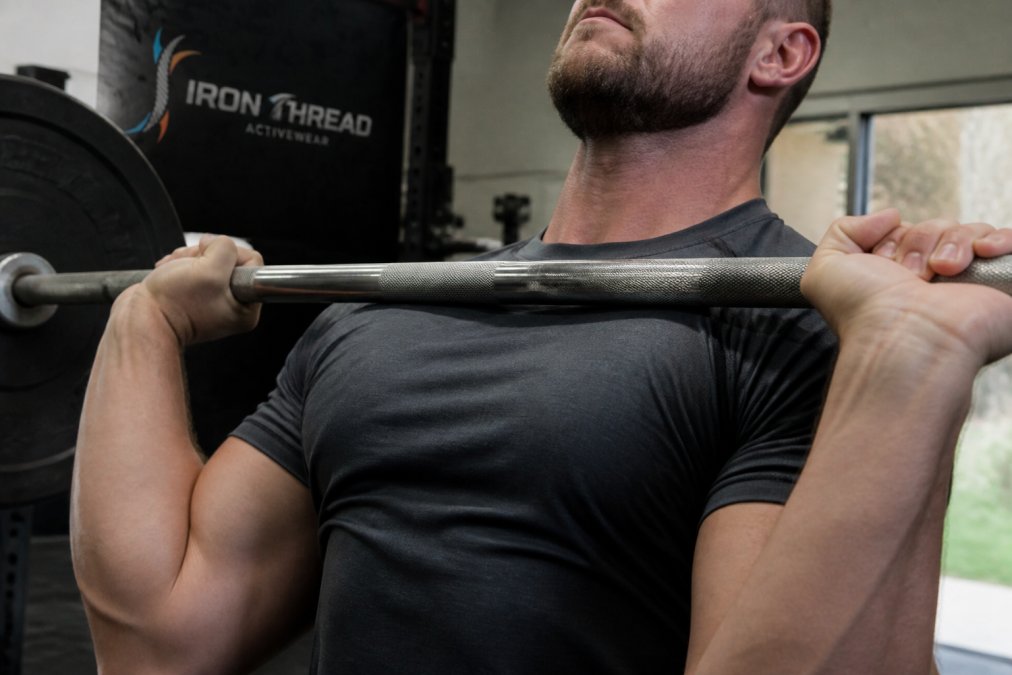
Knurling is the crosshatched pattern cut into a barbell shaft for grip, and it is abrasive by design.
Skin Sensitivity and Contact Dermatitis in Training Gear
Contact dermatitis is skin inflammation caused by direct contact with an irritant, and training apparel can trigger it in two ways. The first is chemical: dyes, finishing agents, and residual detergents left in fabric. The second is mechanical: friction from seams, tags, and rough fabric edges against sweaty skin.
Sustainability and Microplastics in Performance Activewear
Synthetic performance fabrics shed microplastics during washing, and those particles are small enough to pass through standard wastewater filtration. This is a real trade-off in the performance apparel category: the same synthetic fibers that wick sweat and resist abrasion are the ones that shed in the wash.
Practical steps that reduce shedding:
- Wash synthetic gear less often, and spot-clean between sessions
- Use a front-loading machine where possible, which is gentler on fabric
- Wash in cold water on a shorter cycle
- Air dry instead of machine drying
Best Activewear for Strength Training: Matching Fabric to Your Program
The best activewear for strength training matches fabric weight, stretch, and abrasion resistance to the specific demands of your program. There is no single answer, because a powerlifter peaking for a meet has different fabric needs than someone running a five-day hypertrophy split.
Here is how the pieces fit together:
| Training Style | Fabric Priority | GSM Target | Stretch Need |
|---|---|---|---|
| Powerlifting | Abrasion resistance, structure | Midweight to heavyweight | Moderate |
| Bodybuilding | Breathability, moisture transport | Lightweight to midweight | High |
| Cross training | Durability, four-way stretch | Midweight | High |
| Conditioning | Airflow, fast evaporation | Lightweight | Moderate |
| Recovery and layering | Warmth, comfort | Heavyweight | Low |
How to Care for Performance Athletic Wear
Caring for performance athletic wear comes down to protecting the fiber structure that makes it work. Wicking channels, stretch recovery, and anti-microbial treatments all degrade with the wrong washing habits.
A care routine that preserves performance:
- Wash in cold water on a gentle cycle
- Skip fabric softener and dryer sheets entirely
- Use a technical or sport-specific detergent
- Turn garments inside out to reduce surface abrasion
- Air dry whenever possible
- Wash synthetic gear less often than everyday clothing
- Hang immediately after training instead of leaving it in a gym bag
- Avoid washing with heavy items like towels or jeans
Conclusion: Building a Lifting Wardrobe That Lasts
Building a lifting wardrobe that lasts means choosing fabric by function, not by look. Match GSM to your training style, prioritize four-way stretch and abrasion resistance where the bar contacts your body, and treat your gear with a care routine that preserves what makes it work.
Frequently Asked Questions
What is the healthiest fabric to workout in?
Polyester and nylon blends are the healthiest choice for heavy lifting because they wick sweat away from your skin and dry quickly, reducing the risk of chafing and bacterial growth. Natural fibers like cotton absorb sweat and stay wet against your body, which can cause irritation during long sessions. Look for fabrics labeled moisture-wicking with anti-microbial properties. Iron Thread Activewear uses lightweight, breathable performance fabrics designed to manage sweat and keep you comfortable rep after rep.
Which fabric is best for sweat absorption during intense training?
Counterintuitively, the best fabric for sweat management is not the one that absorbs the most. Hydrophobic synthetic fibers like polyester and polyamide move moisture to the fabric surface where it evaporates quickly. Cotton is hygroscopic, meaning it holds water and becomes heavy and clingy. For intense training, choose moisture-wicking synthetics with a wicking rate that pulls sweat off your skin fast. Iron Thread performance tees and tanks are built with sweat-wicking comfort for exactly this reason.
What do weight lifters wear for maximum durability?
Weight lifters should prioritize fabrics with high tensile strength and abrasion resistance. Polyester blends with elastane offer four-way stretch and hold their shape through repeated washing and heavy barbell contact. Seam construction matters too: flatlock or reinforced seams reduce blowouts. Pump covers made from heavyweight fabrics add a durable layering option. Iron Thread Activewear apparel is built to last with durable performance fabrics that hold up rep after rep.
Why does fabric composition matter for heavy lifting?
Fabric composition determines how your gear handles sweat, stretch, friction, and odor. A polyester-elastane blend stretches with your range of motion during squats and deadlifts while resisting barbell friction. Cotton loses shape and holds odor. The wrong fabric can cause chafing, restrict movement, or wear out in weeks. Choosing the right blend means your apparel supports your training instead of distracting from it, which matters when you are focused on progressive overload.
How do I care for performance athletic wear to make it last?
Wash performance activewear in cold water on a gentle cycle and avoid fabric softener, which clogs moisture-wicking fibers. Turn garments inside out to reduce abrasion, and air dry when possible to preserve elasticity. Skip the dryer on high heat because it breaks down elastane and causes stretching or bagging. Following these steps keeps your Iron Thread gear performing through hundreds of training sessions.