
Table of Contents
- Why Leggings Lose Their Shape: Causes and Warning Signs
- Fabric Composition and Compression: What to Look For
- The Importance of Proper Sizing and Waistband Mechanics
- How to Wash Athletic Wear Without Damaging Stretch Fibers
- Best Way to Dry Leggings to Protect Elasticity
- How to Fix Stretched Out Leggings: Repair and Restoration
- Activity-Specific Wear: Lifting, Running, and Recovery
- Frequently Asked Questions
Last Updated: September 13, 2026
Why Leggings Lose Their Shape: Causes and Warning Signs
The short answer: leggings lose shape when stretch fibers fatigue faster than the fabric around them can recover. Every pair of performance leggings relies on spandex (also called elastane) to snap back after it stretches. When that fiber breaks down, the garment keeps the shape it was last stretched into. At Iron Thread Activewear, we build our fabrics around that reality, because how to prevent leggings from losing shape starts with understanding what actually fails.

Heat, harsh detergent, and mechanical agitation are the three biggest accelerators of fiber breakdown. Wear patterns matter just as much. A pair worn for heavy squats three times a week ages differently than one worn for walking.
How Elasticity Fades: Spandex, Elastane, and Fiber Breakdown
Spandex is a segmented polyurethane fiber engineered to stretch several times its length and return to form. Each stretch-and-recover cycle puts stress on the polymer chains inside the fiber. Eventually, those chains slip and the fiber loses its memory.
Chlorine, fabric softener, and high dryer heat speed up that process. Detergent residue left in the fabric also stiffens the fibers, which reduces fabric recovery over time.
Spotting Sagging, Rolling Down, and Pilling Before It Spreads
Catch the warning signs early and you can extend a pair's life by months. Watch for these signals:
- Sagging at the knees or seat after a workout, when the fabric used to snap back within minutes
- Rolling down at the waistband during movement, a sign the elastic has lost tension
- Pilling on the inner thigh where friction rubs fibers together
- Shine or thinning in high-stretch zones like the seat and knees
- Loose seam stitching along the gusset or side seams
Once pilling and sagging appear together, the fabric is telling you the stretch fibers are already compromised. Prevention beats repair at this stage, which is why the next sections focus on what to buy and how to care for it.
Fabric Composition and Compression: What to Look For
The best fabric blend for shape retention combines nylon or polyester with a meaningful percentage of spandex, typically 15 to 25 percent for training leggings. Below that range, the fabric stretches but struggles to recover.
Nylon and polyester form the structural base of the garment. Spandex provides the stretch and recovery. Get the ratio wrong and you get leggings that feel great in the fitting room and baggy by week three.
Compression plays a supporting role here. A fabric with moderate compression holds tension across the garment, which reduces how far the fibers stretch during movement. Less stretch per wear means slower fiber fatigue. That is the mechanical reason compression leggings tend to hold their silhouette longer than loose-fit styles.
Nylon, Polyester, and Spandex Blends for Shape Retention
Nylon-spandex blends feel softer and smoother against the skin, which suits yoga, recovery wear, and everyday training. Nylon resists abrasion well, though it holds moisture slightly longer than polyester. For care, turn nylon-spandex inside out and wash in cold water with a mild detergent, nylon is prone to snagging, so avoid washing with hooks or zippers.
Polyester-spandex blends dry faster and handle heavy sweat better, making them the stronger choice for high-intensity training and running. Polyester also resists pilling better under friction. However, polyester attracts oils, so pre-treat any oily stains with a dab of dish soap before washing. Always air dry to prevent heat damage to the spandex.
Cotton-spandex blends are comfortable for light activity but have low shape retention because cotton fibers lack the resilience of synthetics. They also absorb moisture and dry slowly, which can lead to sagging. If you wear cotton blends, wash them separately in cold water and avoid fabric softener, which coats the spandex.
Polyester-only leggings are budget-friendly but offer minimal stretch and recovery. They may feel tight initially but quickly bag out at the knees and seat. Care is simple: machine wash cold and tumble dry low, but expect a shorter lifespan.
| Fabric Blend | Best For | Shape Retention | Drying Speed | Care Notes |
|---|---|---|---|---|
| Nylon-spandex | Yoga, recovery, everyday wear | High | Moderate | Cold wash, inside out, avoid snags |
| Polyester-spandex | Running, HIIT, heavy sweat | High | Fast | Cold wash, pre-treat oils, air dry |
| Cotton-spandex | Light activity only | Low | Slow | Cold wash, no softener, air dry |
| Polyester only | Budget basics | Low | Fast | Machine wash cold, tumble low |
The Importance of Proper Sizing and Waistband Mechanics
Sizing is the most overlooked factor in garment longevity. Leggings that are too small stretch past their engineered limit every time you put them on, which fatigues the spandex faster than any wash cycle will. Leggings that are too large slide and bunch, which stresses the seams instead.
Use the brand's size guide and take your measurements rather than guessing from your usual size. A fit test tells you more than a label does: squat, lunge, and bend in the fitting room. The waistband should stay put without digging in, and the fabric should feel supportive without pulling tight across the hips.
High-Rise vs. Mid-Rise: Which Waistband Holds Better
High-rise waistbands generally hold position better during lifting and bending because they sit above the hip bone, where there is less movement to push the band down. The wider band also distributes tension across more surface area, which reduces rolling.
Mid-rise styles work well for running and lower-impact training, where the torso stays more upright. If your waistband rolls down mid-workout, the band is either too narrow, too stretched, or sitting at the wrong point on your torso.
How to Measure for a No-Slip Fit
Most fit issues stem from hip-to-waist ratio differences. To find leggings that stay put, measure your waist at the narrowest point and your hips at the fullest point. If your hip measurement is more than 10 inches larger than your waist, you may need a curvy fit or a style with a higher spandex content to accommodate the difference without gapping at the waist.
Use a soft measuring tape and keep it snug but not tight. Compare your measurements to the brand's size chart, and if you fall between sizes, size up, you can always tailor the waistband, but you cannot add fabric.
For a personalized fit, consider styles with adjustable waistbands or drawcords. Our Threads Women's Performance Leggings feature a high-rise supportive waistband that accommodates a range of hip-to-waist ratios without slipping.
How to Wash Athletic Wear Without Damaging Stretch Fibers
Wash leggings in cold water on a delicate cycle, inside out, with a mild detergent and no fabric softener. That single routine protects stretch fibers better than any specialty product on the market.
Heat is the enemy. Hot water relaxes the fibers and accelerates the breakdown of spandex, while the agitation of a normal cycle grinds fibers against each other and against the drum.
Here is the routine that works:
- Turn leggings inside out to protect the outer surface from pilling
- Place them in a mesh laundry bag to reduce friction
- Use cold water on a delicate or gentle cycle
- Add a small amount of mild, free-and-clear detergent
- Skip fabric softener, bleach, and dryer sheets entirely
- Wash with similar synthetic fabrics, not heavy cotton or towels
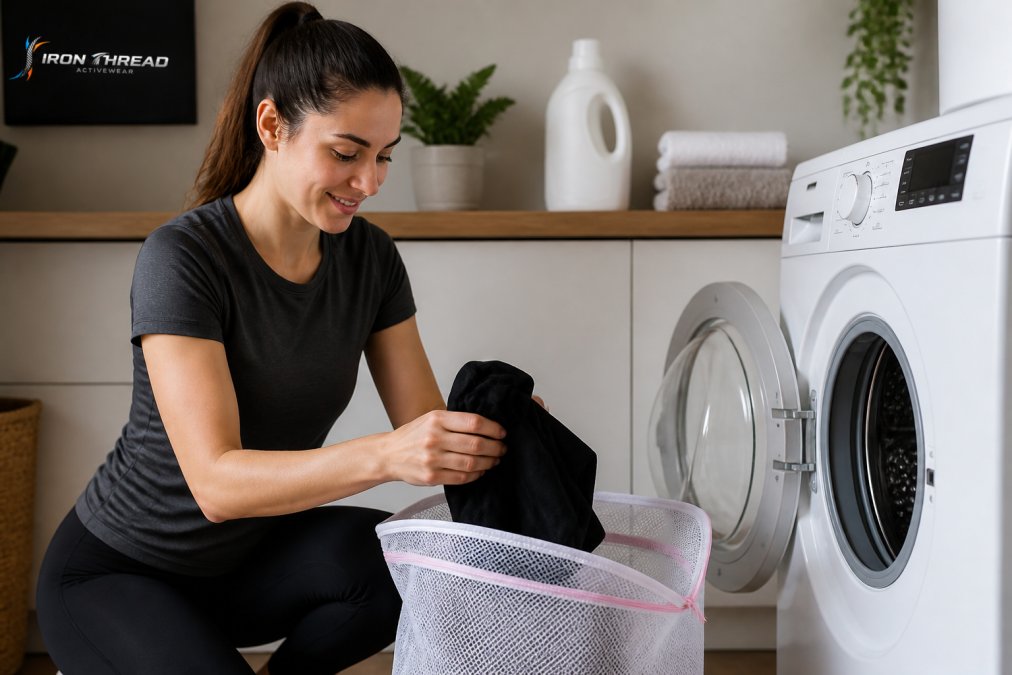
Detergent buildup is a real problem for performance fabrics. Excess soap leaves residue in the fibers, which stiffens the fabric and reduces both wicking and recovery. If your leggings feel stiff after washing, you are likely using too much detergent.
Best Way to Dry Leggings to Protect Elasticity
Air dry leggings flat or hanging, away from direct sunlight and heat sources. This is the best way to dry leggings if you want the elastic to survive past the first few months.
Tumble drying on high heat is the single most damaging thing you can do to spandex (cleaninginstitute.org). The heat breaks down the polymer structure, and the tumbling action stretches fibers while they are warm and most vulnerable. If you must use a dryer, choose the lowest heat setting and pull the leggings out while they are still slightly damp.
Lay leggings flat on a drying rack to preserve their shape, or hang them from the waistband. Avoid hanging them by the ankles, since gravity pulls the fabric downward while it is still wet and heavy.
How to Fix Stretched Out Leggings: Repair and Restoration
You can partially restore stretched leggings, but the results depend on how far the fibers have degraded. If the spandex itself has broken down, no method will fully bring it back. If the fabric is simply fatigued and holding residue, restoration works well.
Try these steps in order:
- Wash with a small amount of white vinegar in the rinse cycle to strip detergent buildup
- Soak in cool water for 15 to 20 minutes, then gently squeeze out excess water without wringing
- Lay flat to dry in the shape you want the leggings to hold
- Apply low, indirect heat from a hair dryer on the cool setting to help the fibers contract slightly
- Never use boiling water, which damages spandex permanently
For minor seam repairs, a simple stitch with matching thread extends the garment's life. For waistbands that have lost tension, a tailor can sometimes replace the elastic, though the cost rarely justifies it on lower-priced leggings.
Activity-Specific Wear: Lifting, Running, and Recovery
Different activities stress leggings in different ways, and matching your gear to the activity extends its life. Impact type drives wear more than total hours worn.
Heavy lifting puts maximum tension on the fabric at the hips and knees during deep squats and deadlifts. Compression leggings with a high spandex percentage handle that load best. Running creates repeated stretch-and-recover cycles at the knees, plus friction between the thighs, so polyester blends with strong abrasion resistance last longer. Recovery wear and lounging cause almost no fiber stress, which is why a pair worn mostly for rest days will outlast a training pair by a wide margin.
A rotation solves this. Keep two or three pairs in active service and let each one rest between wears. Fabric recovery takes time, and a pair worn daily never gets the chance to return to its original shape. Our Threads Women's Performance Leggings are built with a high-rise supportive waistband and moisture-wicking fabric designed for exactly this kind of rotation, and the Threads Women's Performance Legging Shorts handle the same training load in a shorter cut for warmer sessions.

The care routine matters just as much as the garment. Following FTC guidance on textile care labeling helps you read and follow whatever care instructions come with your gear, and the American Cleaning Institute's fabric care resources covers the detergent and wash-temp questions that come up most often.
Frequently Asked Questions
Why do my leggings keep falling down when I walk?
Leggings slide down when the waistband loses elasticity or the fabric has stretched beyond recovery. This often happens after repeated hot-water washes or tumble drying, which breaks down spandex fibers. Choosing a high-rise style with a wide, supportive waistband and washing in cold water can help. If the waistband no longer snaps back, it may be time to replace that pair.
Can you shrink leggings back to their original shape?
You can temporarily tighten leggings by soaking them in hot water and air drying, but this stresses the elastic fibers and shortens their lifespan. A better approach is to wash in cold water and lay flat to dry. For minor sagging, a gentle warm rinse followed by air drying can help, but once the elastic is permanently stretched, restoration is limited. Prevention through proper care is more effective than shrinking.
How often should you replace high-performance leggings?
With proper care, high-performance leggings can last one to two years of regular training. Replace them when you notice permanent sagging, thinning fabric, or a waistband that no longer stays up. Rotating between two or three pairs extends their life. Investing in quality fabrics like those from Iron Thread Activewear can delay replacement and keep your gear performing.
What is the best way to store leggings to maintain fit?
Fold leggings and store them flat in a drawer rather than hanging them by the waistband, which can stretch the elastic over time. Avoid cramming them into tight spaces that create creases. Keep them away from direct sunlight and heat. Proper storage, combined with cold washing and air drying, helps leggings keep their shape between workouts.
Leggings that lose their shape force you to replace them constantly, which costs more over a year than buying one durable pair. Iron Thread Activewear builds performance apparel for athletes who train through the hard days, with premium fabrics, a sculpting athletic fit, and a high-rise waistband designed to hold through every rep and reset. Shop by collection and get gear that shows up when you do.